Text or Image? The Time–Quality Trade-off in AI Video Generation
Every AI video project begins with the same question: how much time should I invest before I hit generate?
After a few months of production work, I've settled on a simple mental model. It plots two things, the time I put in and the quality I get out, and compares three ways of working: text-based AI generation, image-based AI generation, and traditional production.
The curves below are illustrative. They're drawn from experience, not measured data. But they've been a useful way to decide which approach to reach for.
Speed or Control: Two Ways In
Image-based: more control, more time
With image-based generation, you give the model images to work from. You spend the time upfront designing and preparing those images, and the more frames or references you prepare, the more time it takes.
- storyboard → video
- start frame + end frame → video
- video → video
Text-based: fast to test, less control
With text-based generation, you describe what you want and let the model, or an LLM in front of it, design the shots for you.
- text → video
- idea → LLM prompt rewriter → video (a better result without spending more time)
- long script → multi-stage pipeline (split into shots, generate each) → video (handles long scripts without losing quality)
Time vs. Quality

-
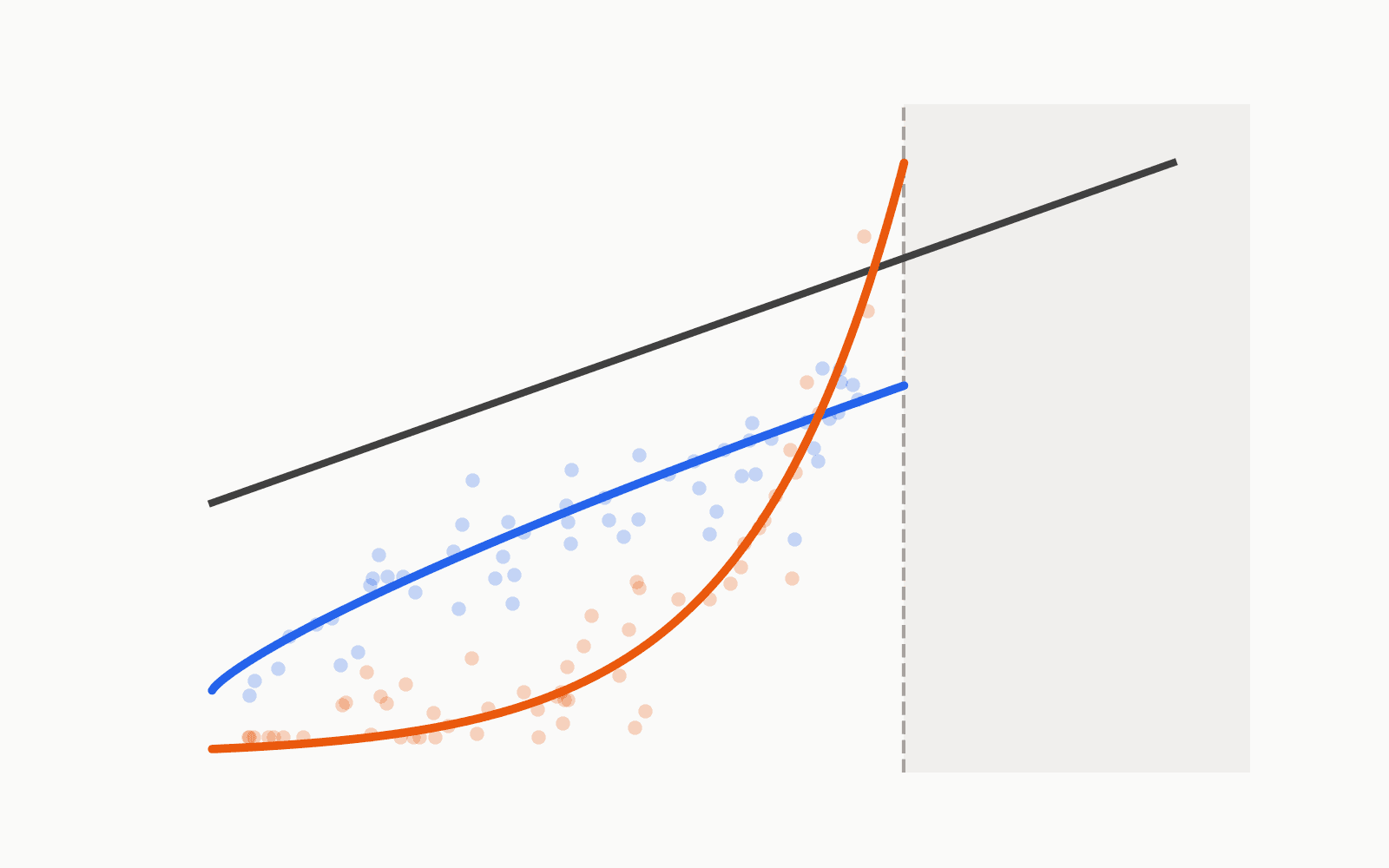
Traditional production: a high upfront cost (setup, assets, pipeline), then time grows roughly linearly with quality. It's slow, but there's no hard ceiling.
-
Text-based (orange): fast to start. You get a low-quality result for very little time. But the cost rises steeply as you push for quality, and it climbs sharply as you approach the model's ceiling. Each extra step of quality means more rerolls and more prompt tweaking. It's best for prototyping and testing ideas.
-
Image-based (blue): a higher upfront investment, because you're preparing reference images, storyboards, or start and end frames. But the cost grows gently and stays manageable all the way to the ceiling. This is the better bet when you need real control over composition, motion, or style.
-
The crossover: for lower quality targets, text-based is cheaper. Past the crossover point, image-based gets you the same quality in less time.
The Quality Ceiling

Every model has a quality ceiling: the highest quality it can reliably produce today, both in visual fidelity and in how precisely it follows what you ask for. Below the ceiling, AI is usually the faster route. Above it, no amount of prompting or reference preparation will get you there, and traditional production is the only option.
The ceiling isn't fixed, though. It moves up with every model generation, and the region where AI is the right tool keeps growing.
Real-World Variance

The curves above are averages. In practice, AI generation has significant variance, and individual results scatter widely around the expected curve.
-
Bad luck (blue): I spent a long time drawing reference frames for every shot, and the output was still unusable. High investment, low quality. This happens.
-
Good luck (orange): I gave the model nothing but a text script and got a surprisingly good result near the ceiling, with almost no time spent. This also happens.
-
The core risk of AI production: because of this randomness, you can invest a lot and still fail completely. A big time bet doesn't always pay off.
-
Why traditional production handles this better: traditional workflows are far more deterministic. The output tracks the skill and time you put in much more closely, without sudden collapses where a big investment yields nothing. You get less lucky upside, but much less catastrophic downside.
Practical takeaway: use text-based generation for cheap exploration, where failure is cheap to absorb. Switch to image-based when you need predictable control and lower variance. Fall back to traditional production when the stakes are too high to gamble on model randomness.
This connects to a broader question I wrote about in End-to-End vs. Hybrid AI Video Pipelines: how much structure you put between the idea and the pixels. Text-based and image-based generation are two points on that same spectrum.